Updated: July 17, 2026
The NYC Department of Buildings has proposed an amendment to 1 RCNY 5000-01, the rule that governs how design and construction teams demonstrate and document Energy Code compliance. In DOB’s words, the rule conforms the requirements to the New York City Energy Conservation Code and implements code requirements tied to updates in the New York State Energy Code. The underlying update was made by Local Law 47 of 2026, which was enacted on December 18, 2025.
Because this is a proposed rule, DOB will hold a public hearing and accept public comment before it becomes final. Here is what the proposal covers, and how to weigh in.
What the proposed rule changes
DOB frames the amendment around several core updates to 1 RCNY 5000-01:
1. Conforming references to the 2025 code. Throughout the rule, references shift from the 2020 NYCECC and ASHRAE 90.1-2016 to the 2025 NYCECC, the 2025 NYS Energy Code, and the New York City amendments to 2025 ASHRAE 90.1. New defined terms are added, including 2025 NYS/NYC ASHRAE 90.1, Character-Defining Features, Lead Energy Professional, and Material Compliance Change.
2. A new HVAC compliance path: Total System Performance Ratio (TSPR). The proposal adds TSPR as a route to demonstrate HVAC compliance under NYCECC Section C409 or ASHRAE 90.1 Section 6.6.2. Projects using it must model with NYC-specific TSPR software, meet 2025 NYC ASHRAE 140 testing and reporting requirements, and submit a compliance report documenting building geometry, thermal blocks, envelope parameters, HVAC characteristics, annual energy use, and the calculated TSPR for both the proposed and baseline designs.
3. A rebuilt approach to thermal bridging. The prior narrative provisions are replaced with a structured framework. It sets a defined list of intersections that must be evaluated, including structural framing, cladding attachments, roof edges and parapets, and floor-to-wall and balcony interfaces. It requires documentation of mitigated versus unmitigated bridges, with psi (ψ) and chi (χ) factors drawn from code tables, ASHRAE 90.1 Appendix A10, or approved thermal analysis, all captured in a standardized linear thermal bridge table.
4. Additional efficiency, renewable, and load-management credits. The rule adds explicit documentation for additional energy-efficiency credits (Sections R408, C406, or Section 11) and, for commercial buildings, renewable-energy and load-management credits (Section C406.3). Credits must be summarized in dedicated tables in the main filing and weighted by gross conditioned floor area for mixed-occupancy projects. Where credits exceed the minimum, they may be traded between the efficiency and renewable/load-management requirements.
5. A partial exemption for historic buildings. The proposal removes the prior blanket exemption for alterations to historic buildings and replaces it with a partial exemption path. Applicants must submit a Historic Building Report establishing historic status, identifying the character-defining features within the scope of work, and demonstrating how compliance with specific provisions would threaten or degrade the building’s historic form, fabric, or function.
6. Energy modeler qualifications. Modeling documentation must identify the responsible individual and be signed and sealed by either a registered design professional with at least two years of energy-modeling experience on comparable buildings, or an individual holding an active ASHRAE Building Energy Modeling Professional (BEMP) certification.
7. Expanded air-barrier testing and updated progress inspections. The commercial air-barrier provisions move toward requiring a whole-building air-leakage testing statement, with a guarded-testing option (ASTM E3158) for buildings 50,000 square feet and greater. Progress-inspection Tables I and II are updated throughout. “Periodic” and “continuous” now carry the same meanings as “special inspection” under Building Code Chapter 2, and inspection frequencies are tied to specific phases of construction.
Why this matters for your projects
If your teams file energy analyses in New York City, this rule is the day-to-day playbook. It sets which compliance paths are available, what has to appear on the construction documents, how credits are tallied and traded, and what progress inspectors will be verifying in the field. Getting the documentation right at filing is what keeps a project moving and helps avoid the rework that comes with an incomplete or invalidated energy analysis.
Since the rule is still proposed, the comment period is a real chance to shape the final language while it can still change.
How to comment or attend the hearing
DOB will hold the public hearing online at 11:00 AM on Thursday, August 27, 2026, via Microsoft Teams. Comments may be submitted through any of the following:
Online: rules.cityofnewyork.us
Email: dobrules@buildings.nyc.gov
Mail: NYC Department of Buildings, Office of the General Counsel, 280 Broadway, 7th Floor, New York, NY 10007
In person at the hearing: sign up to speak by emailing dobrules@buildings.nyc.gov by August 20, 2026 (include name and affiliation; speakers have up to three minutes).
Written comments are due by close of business on August 27, 2026. Requests for a disability accommodation must be submitted by August 13, 2026.
How Cahill Strategies can help
Our team includes former senior NYC Department of Buildings officials who spent their careers inside the agency that writes and enforces these rules. We help construction and design firms translate proposals like this one into concrete filing and documentation obligations, and we help clients weigh in during the comment period so the final rule reflects how work actually gets built.
If you’re part of our New York City construction industry and would like to keep informed of new developments and how your project could be affected, we invite you to sign up for our mailing list. We’ll also send you our complimentary, comprehensive guide to New York City DOB’s new Chapter 33 Building Code revisions.
Cahill Strategies Construction Solutions Guide to NYC Building Code Chapter 33 Revisions
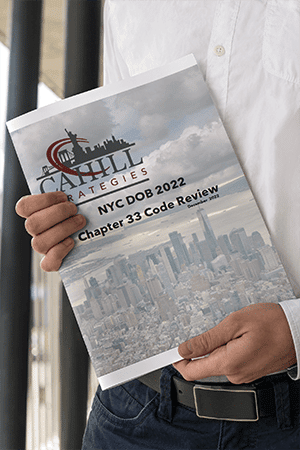
Cahill Strategies has developed a detailed and documented guide to the most important revisions that New York construction professionals are likely to encounter every day. We were able to do this because Cahill Strategies has been involved instrumentally in the development of these codes.
The 100-page book is meticulously organized and can be used as a handy reference when many common issues arise. In each section, the specific revisions are highlighted, and the new information is presented in a clear and practical manner with further explanation on why the change is so important. All of this, reviewed and vetted by one of New York’s longest serving, former DOB professionals – Cahill Strategies’ Director of Construction Code & Safety, Bobby D’Alessio.
More on Our Construction Solutions Team
Cahill Strategies is a team comprised of skilled construction industry strategists dedicated to guiding clients through the intricate regulatory and political landscape, resulting in propelling projects within New York City to completion. Our expertise lies in representing large general contractors, sub-contractors, construction management firms, design professionals, and owners/developers.
- Liaising with City and State regulatory agencies such as NYC DOB, DOT, FDNY, DEP, Landmarks, HPD, DOF, DOH, DOE, and others;
- Liaising with elected officials and other stakeholders such as NYC Mayor, City Council, Community Boards, NYS Governor, Senate and Assembly;
- Liaising with public utilities, such as ConEd, National Grid, Water & Sewer;
- Liaising with private utilities and telecommunication companies;
- Facilitating submissions to City and State regulatory agencies, Community Boards and other decision makers for project support and approval;
- Consultation on Stop Work Orders, Violations, Commissioner’s Orders and other enforcement actions; and
- Consultation and negotiating fines with the NYC or NYS Department of Finance, and other City and State regulatory agencies.
New York Construction Solutions
Cahill Strategies has experience representing large general contractors, construction management firms, owners, and developers. A key to our success is our vast network of decision makers that we have the ability to reach on your behalf. Additionally, our team is involved in the legislative and regulatory processes at the Federal, State, and Local levels which affect the construction industry in New York State, New York City, and surrounding regions. We possess the knowledge of industry standards and trends, along with key relationships that will bring your projects to fruition. Read more…
Receive Our Construction Updates…
Helpful Links:
Contact Us:
Get to know Bobby D’Alessio
 Robert “Bobby” D’Alessio, is a former New York City Department of Buildings Senior Executive Director of Construction Safety. Mr. D’Alessio’s focus is predominately in the areas of construction code and safety analysis for our clients’ major new building and renovation projects in the New York City and surrounding regions.
As Cahill Strategies’ Director of Construction Code and Safety, Bobby brings an unparalleled level of knowledge and practical experience to our growing construction solutions practice area.
 Cahill Strategies Welcomes Former NYC DOB Director of Construction Safety Enforcement, Bernie Ross
 Cahill Strategies Welcomes Former NYC DOB Director of Construction Safety Enforcement, Bernie Ross
It is with great pleasure that Cahill Strategies welcomes veteran DOB safety leader Bernie Ross as Senior Construction Safety Associate.
Bernard “Bernie” Ross is former New York City Department of Buildings Director of Construction Safety Enforcement. With more than 20 years serving the DOB as a Construction Inspector, Supervising Inspector, Director Major Projects, and finally, Director of Construction Safety Enforcement. Read more about Bernie here…
Get to know Kevin Moran
 Kevin, the Vice President of Construction Solutions at Cahill Strategies, brings a wealth of experience in the New York construction industry to his role. He has a strong track record of guiding clients through complex building processes, with a range of successful projects under his belt, including commercial and residential developments, infrastructure and transportation projects, and various utility matters.