Updated: May 6, 2026
The New York City Department of Buildings (DOB) adopted amendments to Chapter 11 of Title 1 of the Rules of the City of New York governing elevators, escalators, personnel hoists, and moving walks on May 5, 2026. The rules repeal the existing Chapter 11 provisions — many of which were outdated or duplicated elsewhere — and move key provisions to updated sections under a new numbering structure.
What Is Being Repealed?
Sections 11-02, 11-03, 11-04, and 11-06 of the existing Chapter 11 rules are all repealed in full. Section 11-02 covered elevator and escalator violations constituting a condition dangerous to human safety. Section 11-03 addressed cease use orders. Section 11-04 related to separability. Section 11-06 governed temporary use permits and renewal fees. The substance of these provisions is not disappearing — it is being reorganized and updated under new section numbers.
New Section 102-08 — Cease Use Orders
The cease use order provision moves from section 11-03 to a new section 102-08. Under this section, a cease use order will be issued for all elevators, escalators, personnel hoists, and moving walks whenever any service equipment is or may be dangerous to life, health, or safety. The device will be tagged as unsafe, and the tag may not be removed without prior department approval. Before service can be restored, the owner must pay a $65 fee — which the department is already authorized to charge under Section 28-207.5.1 of the Administrative Code and Section 101-03 of the department’s rules — and the department must rescind the cease use order in accordance with Section 28-207.5.1 of the Administrative Code.
Conditions triggering a cease use order include, but are not limited to: elevators running with open hoistway doors or car gate/door; elevators running with broken or non-functioning upper or lower final hoistway or machine limit switches; hoistway or car door vision glass and grille guard missing; unraveling or broken hoist, counterweight, governor, or compensation cables; missing hoistway door or car door gibs; inoperable governor; elevator running with non-functioning interlock; emergency top exit cover missing (passenger elevator); side emergency exit door open (passenger elevator); emergency stop switch not working (automatic elevator, escalator, or moving walk); directional switch not working (escalator or moving walk); and any other dangerous conditions as observed by the inspector.
New Section 103-19 — Violations Constituting a Condition Dangerous to Human Life and Safety
This section consolidates dangerous condition violations and establishes when the department may take daily enforcement action against a building owner following issuance of an immediately hazardous violation. Key provisions include:
- If all elevators in a building or building section are out of service, an owner with elevator service outages extending beyond 14 days is required to provide alternative accommodations to tenants. Acceptable alternatives include: installation of a temporary vertical transportation device in the building; relocation of tenants to portions of the building where an elevator is not required by section 3002.4 of the NYC Building Code, except that individuals with disabilities must be relocated to an accessible space on the ground floor; relocation of tenants to a building with elevator service; or reimbursement of tenant expenses related to hotel or other lodging costs.
- The owner must post a notice of tenants’ rights to alternative accommodations adjacent to the elevator hall call buttons in a conspicuous area on each floor where the elevators are out of service.
- For outages beyond 14 days, the owner must provide proof of a practical difficulty and an elevator restoration schedule to the department. Acceptable proof includes, but is not limited to, letters from part manufacturers or authorized part distributors.
The section also enumerates specific dangerous conditions subject to daily enforcement, including: defective Firefighters’ Emergency Operation; badly worn, defective, or damaged hoist cables and/or governors cables; defective hoistway doors; defective hoistway door interlocks; defective car door/gate; defective car door/gate switch; defective/missing vision panels; defective car safety devices; defective brake assembly; defective hoist machine; defective selector/assembly; missing top emergency covers; defective escalator fire shutters; defective escalator comb plates; defective escalator stop switch; excessive escalator skirt panel clearances; defective or non-functional safety switches; badly worn, defective, or damaged relays or controllers and/or selector; defective, badly worn, or damaged car safety device parts; defective car and/or counterweight buffers; and any damaged, badly worn, or defective equipment which could result in elevator breakdown.
New Section 103-20 — Failure to Keep Scheduled Inspection or Test Appointments
Scheduled inspection and test appointments for elevators, escalators, and other devices listed in Chapter 30 of the NYC Building Code may be canceled no later than two business days prior to the appointment. Where an inspector arrives and is unable to perform the inspection because the owner or its authorized representative failed to cancel in time or is unprepared, the department will impose a $200 fee. The fee is due and payable within thirty days after the date of the missed appointment or prior to the scheduling of a new appointment, whichever is earlier.
New Section 103-21 — Pre-Inspection Clearance Fee
An owner or authorized representative may request a pre-inspection clearance of an elevator, escalator, or other device listed in Chapter 30 of the NYC Building Code within five business days of the department’s receipt of the request and payment of the required fee of $815 per device. The department reserves the right to schedule the pre-inspection clearance during hours that are operationally feasible, including non-standard business hours.
New Section 3009-01 — Renewal of Temporary Use Certificates
Temporary use certificates issued under Section 3009.3 of the NYC Building Code may be renewed subject to the following requirements: the renewal application must be submitted no later than five business days before the certificate’s expiration date, in a form and manner acceptable to the department; the application must state the reason for renewal and be accompanied by the required fee as set forth in subdivision (c) of the section; and the application must be submitted on behalf of the owner and signed by the owner or authorized representative. The department may require an inspection prior to issuing a renewal. The fee for each renewal application is $100 per device.
If you’re part of our New York City construction industry and would like to keep informed of new developments and how your project could be affected, we invite you to sign up for our mailing list. We’ll also send you our complimentary, comprehensive guide to New York City DOB’s new Chapter 33 Building Code revisions.
Cahill Strategies Construction Solutions Guide to NYC Building Code Chapter 33 Revisions
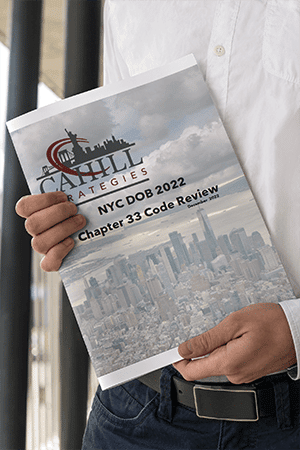
Cahill Strategies has developed a detailed and documented guide to the most important revisions that New York construction professionals are likely to encounter every day. We were able to do this because Cahill Strategies has been involved instrumentally in the development of these codes.
The 100-page book is meticulously organized and can be used as a handy reference when many common issues arise. In each section, the specific revisions are highlighted, and the new information is presented in a clear and practical manner with further explanation on why the change is so important. All of this, reviewed and vetted by one of New York’s longest serving, former DOB professionals – Cahill Strategies’ Director of Construction Code & Safety, Bobby D’Alessio.
More on Our Construction Solutions Team
Cahill Strategies is a team comprised of skilled construction industry strategists dedicated to guiding clients through the intricate regulatory and political landscape, resulting in propelling projects within New York City to completion. Our expertise lies in representing large general contractors, sub-contractors, construction management firms, design professionals, and owners/developers.
- Liaising with City and State regulatory agencies such as NYC DOB, DOT, FDNY, DEP, Landmarks, HPD, DOF, DOH, DOE, and others;
- Liaising with elected officials and other stakeholders such as NYC Mayor, City Council, Community Boards, NYS Governor, Senate and Assembly;
- Liaising with public utilities, such as ConEd, National Grid, Water & Sewer;
- Liaising with private utilities and telecommunication companies;
- Facilitating submissions to City and State regulatory agencies, Community Boards and other decision makers for project support and approval;
- Consultation on Stop Work Orders, Violations, Commissioner’s Orders and other enforcement actions; and
- Consultation and negotiating fines with the NYC or NYS Department of Finance, and other City and State regulatory agencies.
New York Construction Solutions
Cahill Strategies has experience representing large general contractors, construction management firms, owners, and developers. A key to our success is our vast network of decision makers that we have the ability to reach on your behalf. Additionally, our team is involved in the legislative and regulatory processes at the Federal, State, and Local levels which affect the construction industry in New York State, New York City, and surrounding regions. We possess the knowledge of industry standards and trends, along with key relationships that will bring your projects to fruition. Read more…
Receive Our Construction Updates…
Helpful Links:
Contact Us:
Get to know Bobby D’Alessio
 Robert “Bobby” D’Alessio, is a former New York City Department of Buildings Senior Executive Director of Construction Safety. Mr. D’Alessio’s focus is predominately in the areas of construction code and safety analysis for our clients’ major new building and renovation projects in the New York City and surrounding regions.
As Cahill Strategies’ Director of Construction Code and Safety, Bobby brings an unparalleled level of knowledge and practical experience to our growing construction solutions practice area.
 Cahill Strategies Welcomes Former NYC DOB Director of Construction Safety Enforcement, Bernie Ross
 Cahill Strategies Welcomes Former NYC DOB Director of Construction Safety Enforcement, Bernie Ross
It is with great pleasure that Cahill Strategies welcomes veteran DOB safety leader Bernie Ross as Senior Construction Safety Associate.
Bernard “Bernie” Ross is former New York City Department of Buildings Director of Construction Safety Enforcement. With more than 20 years serving the DOB as a Construction Inspector, Supervising Inspector, Director Major Projects, and finally, Director of Construction Safety Enforcement. Read more about Bernie here…
Get to know Kevin Moran
 Kevin, the Vice President of Construction Solutions at Cahill Strategies, brings a wealth of experience in the New York construction industry to his role. He has a strong track record of guiding clients through complex building processes, with a range of successful projects under his belt, including commercial and residential developments, infrastructure and transportation projects, and various utility matters.